
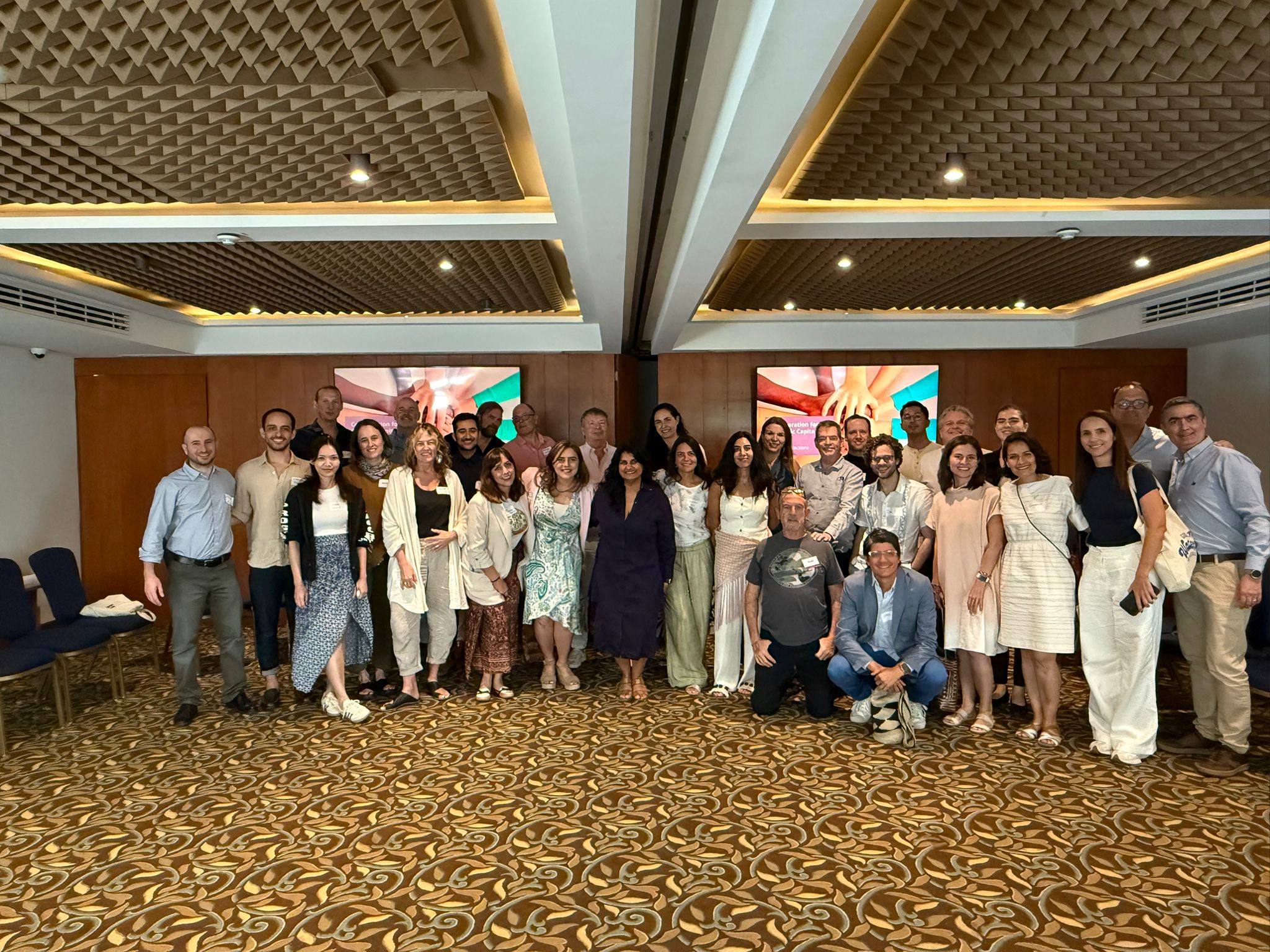
In late February 2026, just ahead of the Foro Latinoamericano de Inversión de Impacto (FLII), a targeted group of over 50 impact investors converged in Mérida, Mexico, to explore collaboration for catalytic capital in Latin America. These investors represent a broad and diverse spectrum of the financial ecosystem, spanning individual investors, family offices, foundations, funds, development finance institutions (DFIs), and non-profit organizations.
Hosted by Toniic and supported by the Catalytic Capital Consortium (C3), the gathering surfaced a profound regional paradox: Latin America possesses immense natural and human capital, yet it remains starved of the patient and risk-tolerant investment capital. With over 80% of the attendees already actively deploying catalytic capital, the dialogue quickly dissected the structural frictions holding back systemic transition, delivering powerful lessons on what it takes to move markets from extraction to regeneration. Here is what we learned.
Redefining the Mandate: Bridge or Pillar?
As practitioners started to compare their individual approaches in deploying catalytic capital, a debate emerged regarding its ultimate mandate. Is its purpose to be a temporary bridge, absorbing risk only until a company or fund is proven and commercial capital flows? Or must it serve as a permanent pillar? Is the ultimate goal of catalytic capital to derisk and pave the way for commercial investors, or is it successful even when it can sustain business models that won’t likely attract commercial investors, even when proven?
The opinions pointed toward a dual reality. While de-risking new technologies or first-time fund managers serves as a classic bridge, addressing deep structural inequalities, such as serving hard-to-reach, low-margin populations, often requires permanent concessionary support.
The Takeaway: We must stop expecting all catalytic capital to eventually pave the way for commercial investors. In markets and models where the fundamental math of serving vulnerable communities or regenerating degraded landscapes does not align with commercial return expectations, catalytic capital is the required foundation.
The Perception Gap in Latin America and the Overreliance on Debt
A recurring theme throughout the morning was the persistent friction between the ground truth of Latin American markets and the global perception of risk. During a candid exchange featuring Latimpacto and the elea Foundation, speakers highlighted how global capital frequently bypasses Latin America, treating the region as inherently high risk compared to other emerging markets.
This macro-perception creates severe micro-level bottlenecks. Capital flows remain heavily concentrated in major economies like Mexico, Colombia, and Brazil, leaving Central America and smaller South American markets largely overlooked. At the same time, there is a structural mismatch in the type of capital available. Investors often favor debt when early-stage enterprises need patient equity and ecosystem support. As a result, many promising impact ventures remain trapped in cycles of small loans rather than building the governance, resilience, and scale required for long-term growth.The Takeaway: Addressing the “missing middle” capital gap remains one of the most critical challenges for investors in Latin America. Catalytic capital must step in with more diverse and intentional structures, absorbing early risk, aligning incentives, and ultimately helping transform promising sectors into investable markets.

Engineering the Capital Stack: The Mechanics of Mobilization
Visionary impact requires structural ingenuity. In a mid-morning deep dive on integrated capital strategies, Raúl Pomares of Sonen Capital provided a masterclass on the mechanics of multi-tranche blended finance, demonstrating that a capital stack is only as effective as its most junior layer.
Contrasting two U.S.-based economic recovery funds offered a stark lesson. The Southern Opportunity And Resilience (SOAR) Fund deployed a $60 million stack to support underbanked businesses, achieving profound social impact but struggling with financial flexibility because its first-loss layer was capped at a thin 12%. Conversely, the California Rebuilding Fund performed significantly better financially while maintaining deep impact, driven by a robust 33% first-loss position absorbed by the government.
Beyond hard structural math, the room explored the power of soft catalysis. When an institutional US based Foundation made an early, public anchor commitment to EWA Capital, VC fund advancing gender equity and transformative partnerships in Latin America, it provided a vital market signal.The Takeaway: Complex blended structures look brilliant on paper, but their real-world success hinges on adequate first-loss protection. Furthermore, an investor’s most catalytic asset is sometimes not their money, but their institutional credibility, which provides the stamp of approval necessary to crowd in highly risk-averse institutional capital.
Financing the Transition: Soil as the Original Capital
Moving into the late-morning session, the focus shifted towards harnessing catalytic capital to structure investments in one of the most important resources in the region: conservation and biodiversity. We discussed how we can leverage catalytic capital to structuring conservation and nature-based investments. With agriculture sitting at the nexus of human survival and climate resilience, practitioners agreed that soil fertility is the ultimate, original producer of capital.
Three distinct regional models showcased how to finance the transition away from monoculture and extraction:
- Regenera Ventures (Mexico): Structuring a pioneer $25 million fund for the regenerative transition, Regenera identified that traditional insurance and supply chains actively penalize biodiversity. To unlock a $5.3million senior commitment from the IDB and the Green Climate Fund, they engineered a $1 million catalytic first-loss layer. Their guiding philosophy for their gender-climate fund served as a provocation for the room: “Ecology without social justice is just gardening.”
- Vox Capital (Brazil): Launching the $200 million Catalytic Capital for Agriculture Transition (CCAT) fund, Vox is acting as a market-maker. By pairing a philanthropic junior share with a senior share targeting a 6% return, they are financing the regeneration of degraded cattle lands in the Amazon and Cerrado by fundamentally shifting market incentives of Amazon farmers and making productive use of degraded land.
- WWF & NUUP (Mexico): Targeting smallholder farmers in Southern Mexico who are largely excluded by traditional banks, this partnership is focused on increasing access to more risk tolerant capital for small holder farmers, via Non-Bank Financial Institutions (NBFIs). The two organizations look to build off of Nuup’s existing work with NBFIs to explore financial instruments and incentives to help smallholders transition to sustainable and regenerative practices.
The Takeaway: We cannot force farmers to bear the financial risk of transitioning global supply chains. Shifting agriculture from extraction to reciprocity requires capital that explicitly pays for ecosystem services and absorbs the upfront friction of change.

The Courage to Collaborate
The Mérida convening proved that unlocking catalytic capital in Latin America is not a question of available funds, but of structural alignment and collective will. Moving forward, the mandate for private investors is clear: step out of isolated silos, share due diligence transparently, and design integrated capital stacks that actively correct market failures.
Catalytic capital is much more than a concession; it is a deliberate act of market-making based on the principle of additionality. By strategically pricing risk to prioritize systemic resilience, these investors are proving that a regenerative, inclusive economy is entirely within reach, if we come together.